
NAID AAA gets mentioned constantly in ITAD marketing, but a lot of people outside the industry aren’t totally sure what it actually confirms. What NAID is NAID, the National Association for Information Destruction, is an independent industry body that certifies data destruction providers. NAID AAA is their highest certification level, and it’s not a one-time…
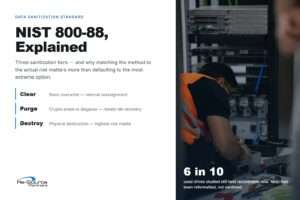
If you’ve ever seen NIST 800-88 compliant on an ITAD vendor’s site and wondered what that actually means in practice, here’s the short version. What NIST 800-88 is NIST Special Publication 800-88 is a guideline published by the National Institute of Standards and Technology that defines methods for sanitizing data from storage media. It’s the…

When an employee leaves a company or a device is retired, someone has to make a decision: wipe it in-house, or send it to a certified IT Asset Disposition (ITAD) vendor. On the surface, in-house data wiping looks like the cheaper, faster option. Most IT teams already have the tools. But the real question isn’t…
Why Your Asset Records Are Probably Wrong Most organizations know roughly what IT hardware they own, but very few know exactly. Laptops get reassigned without a ticket, monitors move between floors, servers are powered down and left in racks, and spare equipment piles up in closets. Each change is small, but over months and years…
Pull the drive, shred it, done. It’s a policy a lot of companies adopted years ago because it felt like the safest option. It’s not wrong, exactly, but it’s usually more expensive and less secure than it looks. The financial side nobody talks about Every laptop, server, or piece of network equipment that still functions…
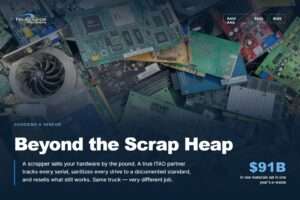
Not every IT “Recycler” that picks up old equipment is doing the same job, even if the truck looks the same. The scrapper model A lot of e-waste vendors operate on a simple model: collect equipment, break it down for commodity materials like metal, plastic, and glass, and sell those raw materials by weight. It’s…
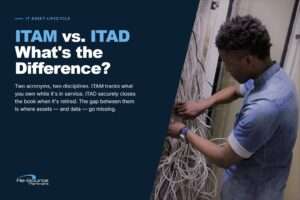
Two acronyms get thrown around in IT circles like they mean the same thing. They don’t, and understanding where one ends and the other begins can save you a lot of headaches, and a little money, down the road. What ITAM actually covers IT Asset Management is the practice of tracking and optimizing your hardware…

Over the past several years, Apple devices have continued to command premium prices. Recent product launches have pushed the cost of new MacBooks, iPads, and iPhones even higher, forcing many organizations to extend refresh cycles and rethink how they manage aging equipment. As rising Apple costs impact IT budgets, they also create an important opportunity…
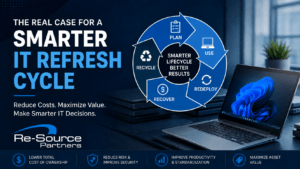
Many organizations look at IT equipment refreshes as a simple cost decision. If a laptop still turns on, why replace it? If a desktop can last another year, why not stretch it? If a closet full of extra devices might be useful someday, why get rid of them? On the surface, waiting longer seems like…

In 2020 and 2021, organizations made rapid, large-scale technology investments to support a remote workforce. Enterprise laptops were deployed at unprecedented volume, often standardized across fleets and aligned to three-year manufacturer warranties from OEMs like Dell Technologies, HP, Lenovo, and Apple Inc. Now, three to four years later, those same assets are reaching refresh eligibility.…
Looking for a better understanding of Hardware Asset
Management? Download one of our helpful resources!